

Sign Language Course in Kenya 2026 at Ikigai College of Interior Design
As Kenya continues to advance conversations around inclusion, accessibility, and equal participation, Kenya Sign Language (KSL) has become increasingly important across education, public service, healthcare, design, and the private sector. Communication accessibility is no longer viewed as a specialised add-on; it is now a core requirement for institutions and professionals working with diverse communities.
In 2026, Ikigai College of Interior Design offers a comprehensive Sign Language course in Kenya that responds directly to these evolving needs. The course is designed to equip learners with practical Kenya Sign Language communication skills while fostering a deeper understanding of Deaf culture, identity, and inclusive practice. It is suitable for both beginners and professionals seeking to strengthen their ability to engage meaningfully with Deaf and hard-of-hearing individuals.
This article provides a detailed overview of the Sign Language course at Ikigai College of Interior Design, including why Kenya Sign Language matters, how the course is structured, who it is designed for, and the practical and professional outcomes learners can expect.
The Importance of Kenya Sign Language in 2026
Kenya Sign Language is recognised under the Constitution of Kenya as one of the official languages of the Republic. It plays a critical role in ensuring access to information, education, justice, healthcare, and public services for Deaf citizens.
Despite this recognition, there remains a significant gap between policy and practice. Many institutions lack staff who can communicate effectively in Kenya Sign Language, and Deaf individuals continue to face barriers in everyday interactions.
Learning Kenya Sign Language contributes to:
- Improved access to services for Deaf and hard-of-hearing people
- Inclusive education and learning environments
- Ethical and respectful communication
- Stronger community engagement
- Compliance with accessibility and inclusion standards
At Ikigai College of Interior Design, the Sign Language course is positioned not only as a language programme, but as part of a broader commitment to inclusion, universal access, and socially responsible practice.
Why Study Sign Language at Ikigai College of Interior Design
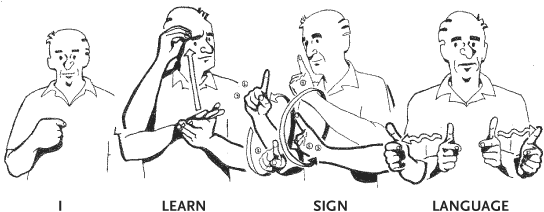
Ikigai College of Interior Design approaches Sign Language education with the same depth, structure, and professionalism applied to its design programmes. The course is carefully developed to balance linguistic competence, cultural understanding, and practical application.
Rather than focusing solely on vocabulary memorisation, the programme emphasises functional communication. Students learn how Kenya Sign Language is used in real-life situations, ensuring that skills acquired in class translate directly to everyday and professional contexts.
The learning environment at Ikigai College of Interior Design encourages active participation, respect for lived experience, and reflective practice, creating a supportive space for learners from diverse backgrounds.
Course Overview: Sign Language Course in Kenya
The Sign Language course at Ikigai College of Interior Design is structured to guide learners from foundational communication skills to confident conversational ability. The curriculum is progressive and allows students to build competence steadily.
The course is suitable for:
- Educators and education support staff
- Healthcare and social service professionals
- Designers, architects, and built-environment practitioners
- Customer service and hospitality professionals
- Government and public sector staff
- Parents, caregivers, and family members of Deaf individuals
- Students and individuals interested in inclusion and accessibility
No prior experience in Sign Language is required for entry at the beginner level.
Foundational Kenya Sign Language Skills

The course begins with a strong foundation in the core elements of Kenya Sign Language. Students are introduced to:
- The manual alphabet and fingerspelling
- Numbers and basic vocabulary
- Sentence structure and grammatical patterns
- Use of facial expressions and body language
- Non-manual signals essential to meaning
From the earliest stages, learners are encouraged to sign clearly and confidently. Emphasis is placed on visual attention, expression, and comprehension, which are fundamental to effective Sign Language communication.
Building Conversational Competence
As learners progress, the course moves beyond basic signs to practical conversational skills. Students learn how to:
- Introduce themselves and others
- Discuss daily activities and routines
- Describe people, places, and environments
- Ask and answer questions
- Express opinions, emotions, and preferences
Interactive exercises, paired practice, and guided role-playing are used extensively. These activities help students internalise language patterns and gain fluency through use rather than repetition alone.
Understanding Deaf Culture and Identity
An essential component of the Sign Language course at Ikigai College of Interior Design is education on Deaf culture. Language and culture are inseparable, and meaningful communication requires cultural understanding.
Students explore:
- Deaf identity and community values
- Social norms and communication etiquette
- Common misconceptions about deafness
- Respectful and ethical engagement
- The role of Sign Language in advocacy and empowerment
This cultural grounding ensures that learners approach Kenya Sign Language with sensitivity, respect, and awareness, rather than viewing it as a technical skill alone.
Practical Learning and Continuous Assessment
Learning Kenya Sign Language is inherently practical. At Ikigai College of Interior Design, lessons are highly interactive, with a strong emphasis on real-time communication.
Students participate in:
- Live signing practice
- Group discussions conducted in Sign Language
- Visual comprehension and interpretation exercises
- Simulated real-world communication scenarios
Assessment focuses on practical competence rather than written theory alone. Learners are evaluated on their ability to understand, express, and respond accurately and confidently in Kenya Sign Language.
Flexible Study Options in 2026
Recognising the diverse needs of learners, Ikigai College of Interior Design offers the Sign Language course through flexible study modes. These may include:
- Day classes
- Evening classes
- Part-time schedules
- Short-course formats
This flexibility allows working professionals, students, and caregivers to access high-quality Sign Language training without disrupting other commitments.
Professional and Career Applications
Completing a Sign Language course at Ikigai College of Interior Design enhances professional competence across multiple sectors. Graduates apply their skills in:
- Schools and educational institutions
- Hospitals, clinics, and rehabilitation centres
- Government offices and public-facing services
- Hospitality, customer service, and retail environments
- Design, architecture, and accessibility-focused projects
- Community development and advocacy organisations
For many professionals, Sign Language skills improve service delivery, ethical practice, and employability. For others, they open pathways into specialised roles that support inclusion and access.
Sign Language, Inclusion, and Universal Design
The Sign Language course at Ikigai College of Interior Design aligns closely with principles of inclusion and universal design. Students are encouraged to understand communication accessibility as part of a broader system that includes physical space, information, and service delivery.
This perspective is particularly valuable for designers and built-environment professionals, who must consider how spaces and systems support diverse users, including Deaf individuals.
Why Choose Ikigai College of Interior Design for Sign Language Training
What distinguishes Ikigai College of Interior Design is its integrated educational philosophy. Sign Language training is approached with the same seriousness, structure, and respect as professional design education.
Students benefit from:
- Experienced instructors with practical knowledge
- A curriculum grounded in real-world communication
- Respect for Deaf culture and lived experience
- A learning environment committed to inclusion and social responsibility
This approach ensures that graduates are not only competent Sign Language users, but also thoughtful and ethical communicators.
Final Thoughts
The Sign Language Course in Kenya 2026 at Ikigai College of Interior Design offers a meaningful and practical pathway for individuals and professionals seeking to develop Kenya Sign Language skills. The course combines linguistic competence, cultural understanding, and real-world application, preparing learners to engage confidently and respectfully with Deaf communities across Kenya.
For those seeking credible, well-structured Sign Language training grounded in inclusion and professional practice, Ikigai College of Interior Design continues to provide a trusted and forward-looking option in 2026.

No Responses